The Hamilton-Montgomery Plantation of north-east Down
THE POLITICAL HISTORY OF IRELAND is more relevant to genealogy than may be expected by non-Irish researchers. For example Philip Robinson describes the Plantation of Ulster as "one of the most politically significant mass migrations to have taken place in Western Europe since medieval times." A careful reading of sources such as his Plantation of Ulster (Gill & Macmillan, Dublin 1984) and Robert Kee's Ireland - A History (London 1980) may well suggest profitable lines of genealogical research for descendants of Ulster Crees.
|

Our attention is focused on the earliest successful plantation, a privately organised Protestant settlement mainly of lowland Scots in north-east Down from 1606 onwards, which pre-dates the official Ulster Plantations. It was led by two Scottish adventurers, Hugh Montgomery and James Hamilton of Ayrshire, with some involvement of the "gullible lord of Upper Clandeboye" as Robinson describes Con McNeill McBrian O'Neill. Robert Kee points out that the settlement "prospered rapidly and became the bridgehead by which, for the rest of the century and beyond, individual Scottish settlers flocked to Northern Ireland."
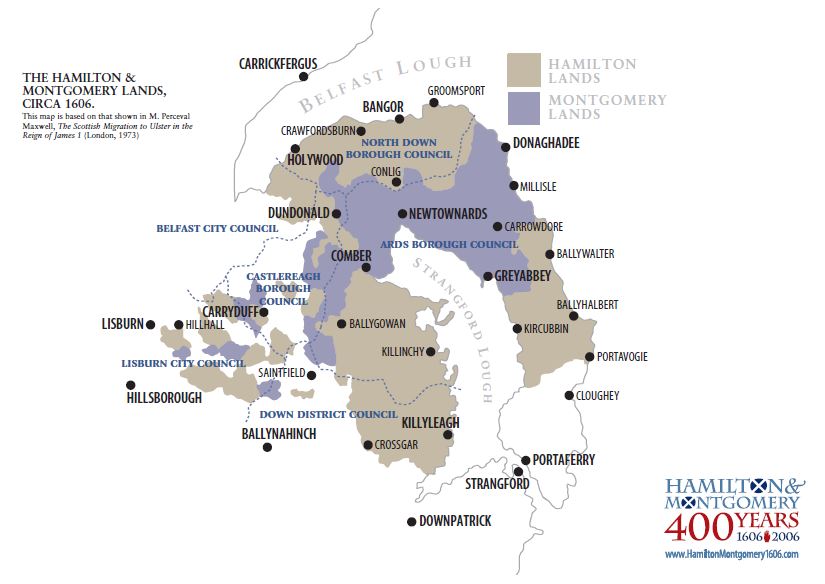
The areas settled by the tenants of Hugh Montgomery and James Hamilton respectively are shown on the map below. Robinson continues, "The area within the Great Ards which Hugh Montgomery obtained lay to the south, that is the countryside around Comber, Newtownards and Greyabbey at the head of Strangford Lough. Hamilton's estates were to the north of these, along the southern shore of Belfast Lough from Holywood to Bangor and Groomsport. Through these grants to Montgomery and Hamilton, foundations were laid for the most concentrated and substantial colony of British to arrive in Ulster during the first half of the seventeenth century."
A detailed record of the early days of the Plantation is given in The Montgomery Manuscripts written some 90 years later (1696 to 1706) by William Montgomery, son of Hugh Montgomery's brother James, from which we show the extract on this page. This sets the scene for the first Cree migrants who arrive from Scotland.
The town of Donaghadee is now a quiet seaside community around the picturesque harbour on the north-east coast of County Down. It is the nearest port to Scotland being just 36 km (22 miles) from Portpatrick. The coast of Galloway is easily visible from Donaghadee and the voyage in the small sailing boats of the early 17th century took three to four hours, depeneding on the tides and the vagaries of the weather. It was the main port of entry to Ireland for migrants of the Montgomery Plantation, which started in 1606 and continued for over a hundred years. Over 10,000 Scots entered Ulster in the first few years. Grants of land in the area were soon taken up and for a while harvests were good on the land which had lain fallow for many years. The earliest known Cree (or Crie) grave, that of Christian Barclay, wife of James Crie, is in the parish churchyard of Donaghadee.
Newtownards or Newtown/Newton as it was known in 1606 was 13 km (8 miles) to the west of Donaghadee. It was the place where Hugh Montgomery first set up his base, using the ruined "stump" of the mediaeval castle for shelter and later the abbey of Movilla a short way to the east. Two of the earliest Cree settlers, Robert Cree and his presumed sister Esther Cree, are buried in the graveyard of Movilla Abbey.
Extract from The Montgomery Manuscripts by William Montgomery (pub, Belfast, 1830)
[p 45:] I now go on with Sir Hugh Montgomery's plantation, which began about May, 1606, and thus it was, viz:-Sir Hugh, after his return from Ireland to Braidstane, in winter 1605, as he had before his coming into Ireland, spoken of the plantation, so he now conduced his prime friends to join him therein, viz: John Shaw of Greenock, Esq. whose sister Elizabeth he had married divers years before that time, and Parick Montgomery, of Black-House, Esq. who married the said John Shaw's sister, Christian... Colonel David Boyd, who bargained for 1000 acres, in Gray Abby parish, Scottish Cunningham measure... Patrick Shaw, Laird of Kelseland (his lady's father's brother) and Hugh Montgomery a cadet of the family of Braidstane... [He lists in similar fashion men by the names of Nevis, Roddin, Cunningham, Moore, Neil, Catherwood,] gentlemen, with many others, and gave them lands in fee farm in Donaghadee parish (all which parish, except some of the town parks, is under fee farm of mortgage,) under small chief rents, but did not assertain the tythes to any of them, nor would he put them into the clergy's hands, because he would keep his tenants from any one's power but his own.
There came over also divers wealthy able men, to whom his Lordship gave tenements in freehold, and parks by lease... They built stone houses, and they traded to enable them to buy land, to France, Flanders, Norway, &c. as they still do...
I desire that this brief account may serve as a sampler of Sir Hugh's 1st essay to his plantation, for it would be tedious... to enumerate all the substantial persons whom he brought or who came to plant in Gray Abby, Newton and corner [=Comber] parishes...
Therefore let us now pause a while, and we shall wonder how this plantation advantaged itself (especially in and about the towns of Donaghadee and Newton), considering that in the spring time, Ao. 1606, those parishes were now more wasted than America...
By the aforesaid Gentlemen's assiduity to people their own farms, which they did, Ao. 1607, after Sir Hugh and his Lady's example, they both being active and intent on the work... then you might see streets and tenements regularly set out, and houses rising as it were out of the ground on a sudden, so that these dwellings became towns immediately.
Yet among all this care and indefatigable industry for their families, a place of God's honor to dwell in was not forgotten nor neglected, for indeed our forefathers were more pious than ourselves, as so soon as said stump of the old castle was so repaired, (as it was in spring time, 1606,) as might be shelter for that year's summer and harvest, for Sir High and for his servants that winter, his piety made some good store of provisions in those fair seasons, towards roofing and fitting the chancel of that church, for the worship of God... and the general free contribution of the planters, some with money, others with handycrafts and many with labouring, was so great and willingly given, that the next year after this, viz. Ao. 1607, before winter it was made decently serviceable, and Sir Hugh had brought over at first two or three Chaplains with him for these parishes. In summer 1608, some of the priory walls were roofed and fitted for his Lady and children and servants (which were many) to live in.
Sir Hugh in the said spring [of 1606] brought with him divers artificers, as smiths, masons, carpenters, &c... They soon made cottages and boothes for themselves because sods and saplins of ashes, alders and birch trees.. with rushes for thatch, and bushes for wattles, were at hand. And also they made a shelter of the said stump of the castle for Sir Hugh, whose residence was mostlie there, as in the centre of being supplied with necessaries from Belfast (but six miles thence), who therefore came and set up a market in Newtown, for profit for both the towns. As likewise in the fair summer season (twice, sometimes thrice, every week they were supplied from Scotland, as Donaghadee was oftener, because but three hours sail from Portpatrick, where they bespoke provisions and necessaries to lade in, to be brought over by their own or that town's boats, whenever wind and weather served them, for there was a constant flux of passengers coming daily over.
|