Part 2 - Cree origins in Perthshire, the 17th Century Plantation of Ulster and the 18th Century “Scotch-Irish” migrations to the USA
by Mike Spathaky
Co-ordinator, Cree One-Name Study
Although genealogical research has shown that the surname Cree does not have one single origin, the numerically most significant group of lines originated in Perthshire, Scotland. A major issue for the Cree One-Name Study is to find conclusive evidence of the descent of the County Down Cree lines from Scottish lines and of the Pennsylvania and New York-New Jersey lines from County Down lines.
|
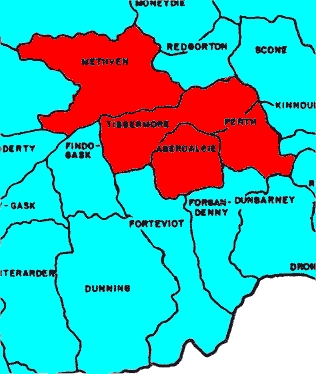
Perthshire: documentary evidence
We have counted thirty Cree (or Crie) nuclear families in the generation 1694 to 1720 in Perthshire. The loss of early parochial registers means that in many cases links between these families cannot easily be verified by conventional genealogical methods. There are at least seven substantial, lines in Perthshire which have not yet been linked by documentary evidence. There are also several separate small family groups that cannot be linked to these main lines but all were from a small group of adjoining parishes (shown in red in Figure 1).
Three of these lines have been traced to different progenitors born before 1600. All three were burgesses of the burgh of Perth. Because these earliest lines originated in Perth itself and because all three were of high status individuals namely burgesses of Perth, we have long suspected that they all descend from a single progenitor.
A Cree line that is traceable back to Sprotbrough, Yorkshire, England, in 1744 has long been thought to be of Scottish origin but with no clear documentary evidence.
Many descendants of these lines have also spread across the English-speaking world and of course there are descendants living in Scotland, Ireland and the USA today.
Cree families in County Down, Ireland
Fig. 2: The Ards Peninsula, Co. Down
|

In Ireland today the Cree surname is best known in and around County Down. Until the 19th century all the Cree families are associated with the group of seven contiguous parishes in County Down, shown in red on the right. As we look further back in the records, we have found only six Cree individuals with birth years before 1700. Five are close enough in birth years to be of a single family. The sixth is probably of the right age to be the father of the others.
Looking at these families we find two points of importance. Firstly this part of the Ards Peninsula, coincides with the area that was intensively settled from lowland Scotland during the Hamilton-Montgomery Plantation starting in about 1607 which acted as a model for the later, official Ulster Plantations. The second feature is that the Cree individuals were married exclusively to partners with surnames deriving from lowland Scotland. Crees even married a Hamilton and a Montgomery, these two being the surnames of the two Scottish adventurers who led that first plantation. The firm conclusion we have drawn is that the County Down Crees are descended from the Cree (or Crie) lines of Perthshire.
Assigning firm relationships between these earliest Irish Crees using documentary evidence is not really possible in the present state of our knowledge, although for some there are strong hints through their geographical affiliations. What is important is that their numbers are low enough to be consistent with descent from one single immigrant family, or individual even, from Scotland.
Cree lines in Pennsylvania
Many Ulster-Scots being Presbyterians found themselves at odds with the English and Church of Ireland establishment and victims along with the Catholic “native Irish” of the penal laws. There are three Cree lines in the USA emanating from Pennsylvania whose ancestors are known to have migrated separately from Ireland, all within a year or two of 1770. Good documentary evidence links these Cree migrant progenitors to Ireland but links with specific County Down families are elusive, although naming patterns are highly suggestive. Another line in New Jersey was tentatively linked to the Pennsylvania lines.
In summary we had excellent grounds, before Y-DNA testing, for believing that the Cree lines from Pennsylvania were descended from County Down families with migration occurring in the 18th century. We suspected that the New Jersey line was also from County Down but possibly from Scotland. We were also very sure that the County Down lines were descended from Scottish Crie families with migration occurring in the 17th century. In all cases the actual person-to-person links at the points of migration had not been identified.
The Cree Y-DNA Project
Y-DNA testing has been in progress for some years now. After early slow progress, an increase in the number of tests undertaken by Cree males in 2012 furthered our knowledge of the genetic links between Cree lines and prompted this review. Tests were all carried out through the Family Tree DNA (FTDNA) company.
Over twenty Cree males have now taken Y-DNA tests (as at April 2017). Except for a single 12-marker test, all tests analysed 37 marker or more. A 37-marker result for a non-Cree has been added to these because his profile shows a close match to some Cree results and not to any other surname. Analysis of the Y-DNA profiles clearly indicates two groups of profiles where the matching within groups is close, and a few additional profiles which do not have any matches.
Of the results which do not have any matches, five are from Cree lines which are known to be separate from the Scottish, Irish and the USA lines. These are discussed in Part 1 of this article. There are two non-matching result. One is from a test subject from one of the Pennsylvania lines and one is a test subject from a County Down Cree line. These two results do not match at all with any other Cree who has been tested and have therefore not been included with the above groups (matching levels 5/12 and 16/37) (see note). Our discussion here focuses on the two groups of matching profiles.
The first of the two groups consists of four test subjects who are USA residents with descent from the Pennsylvania and New Jersey Cree lines, together with one non-Cree test subject. He has the surname McCreery and was born in Ireland with County Down ancestry. In this article we will call this the Pennsylvania-New Jersey or PA/NJ group.
The second group consists of nine test subjects who have documented descent from lines in Perthshire and Fife in Scotland, or are descendants of Cree lines of County Down in Ireland, or (in one case) is a descendant of the Sprotbrough, Yorkshire, line in England. We will call this second group of matching Y-DNA profiles the Scotland group.
Results of the Y-DNA test results (April 2017)
1. All except two members of the PA/NJ group show a high degree of matching to all other members of that group. If we postulate a “mode” Y-DNA profile for the group then one test result matches the mode exactly and none of the results is a worse match than 35/37. The two exceptions had non-matching results and are biologically related neither to the other members of the PA/NJ group of testers nor to any other Cree who has tested.
2. Similarly in the Scotland group, all members show a high degree of matching to all other members of the group, including the three subjects descended from a County Down ancestor. Three test results show an exact (37/37) match and the profile of these two results is the “mode” profile of the group. Four other results each have a 36/37 match and two have 35/37 matches to this mode.
3. There are no significant matches between any members of the PA/NJ group and members of the Scotland group. The mode profiles of the two groups show a match in only 20/37 markers. The MRCAs of all cross-group pairings are 81 to 95 generations back at 50% probability level. That takes us to about 400 BC or earlier!
Analysis of the conclusions from the Y-DNA test results
The first conclusion is not surprising. That the Cree lines of the PA/NJ group are all related* is an expected result considering most of them can trace their ancestries back to migrations from County Down, Ireland, in about 1770 or earlier, when the Cree population in Ireland was quite small and lived in a geographically small and compact area.
The second conclusion is also not surprising. It is consistent with the hypothesis that the Scottish Cree lines are all related (although there are several more yet to be tested). The fact that two members of the group are descendants of a County Down Cree supports the hypothesis of a Scottish origin for the County Down Cree lines and confirms it for that particular County Down line. The results also confirm our hypothesis that the Yorkshire Cree line is descended from a Scottish Cree family.
The third conclusion is the one that is surprising. How can it be that the PA/NJ group, with three separate family migrations from County Down, shows no matching at all with the Scotland group? Bearing in mind that the PA/NJ group also has a match with the McCreery participant who has County Down ancestry, it is indeed a puzzle and we at present can only suggest a tentative scenario, which is given in the Appendix of this DNA subsection.
This is Part 2 of a two-part article which reviews the progress of the Cree Y-DNA Project testing as it stands in April 2013 and attempts to elucidate the implications of the test results for Cree genealogy.
Related articles:
Review Part 1
Analysis
My Results
Appendix
Download file:
Spreadsheet of Cree Y-DNA profiles
Summary
The Cree DNA Project is still at an early stage of its development. Nevertheless it has shown that Y-DNA testing is a powerful tool when used in conjunction with well-developed traditional genealogies such as we have in the Cree One-Name Study. Some of our hypotheses about links between different lines have been confirmed by Y-DNA testing.
Y-DNA testing has established that all the Pennsylvania-New Jersey (PA/NJ) lines tested (except one (see *Note)) are related to each other and to a McCreery test subject who has recent County Down ancestry. The Scottish lines tested are found to be related to each other quite closely - in some cases very closely - together with the descendants of the Yorkshire line and two lines from County Down, Ireland.
The lack of a match between any member of the Scotland group and any member of the USA group is a surprise however. It means we have not proved our hypothesis of descent of the PA/NY Cree lines from Scotland via Ireland. While we set out a scenario to explain the DNA results (in the Appendix), the matter clearly needs further investigation.
Test results are consistent with the separate origins of the Derbyshire Cree line, the Huguenot Cree line and the Massachusetts Cree line from other Cree lines. They have suggested a non-paternity event involving a Humphrey or Humphries male and a Cree female in the Derbyshire line, probably in the late eighteenth century.
More than half of the lines listed in the Cree Geneaology Database now have at least one Y-DNA profile. So future test subjects have a good chance of being matched with a known line as soon as their results are known. Where no immediate match results, a new test result will build up our library of profiles with a good chance of a later test providing meaningful data.
The method of recruiting test subjects by targeting known male Cree contacts has been vindicated by the recruiting campaign which started in December 2012. There are still many Cree lines for which there are as yet no test subjects. Some lines on which testing has been carried out still need additional participants in order to establish baseline profiles for those lines and in some cases to eliminate the possibility that deductions are invalidated by non-paternity events. The main barrier to recruitment is of course the cost of tests and it would be useful if the Cree genealogy community could develop an income stream that would enable a contribution to be made towards the cost of testing. However the results from the tests so far have contributed hugely to our knowledge of the relationships between the Cree lines of Scotland, Ireland and the USA.
*Note: The one exception does not necessarily mean that his line is unrelated. A NPE could be involved somewhere is the particular branch of the test subject. Further test subjects from this line may resolve this issue.
Related articles:
Review Part 1
Analysis
My Results
Appendix
Download file:
Spreadsheet of Cree Y-DNA profiles